

Direct Answer Summary
Yes, insurance agents can use AI voice agents to call leads, but the regulatory framework is specific and the consequences of non-compliance are severe. The FCC’s February 2024 Declaratory Ruling classified AI-generated voices as “artificial” under the Telephone Consumer Protection Act (TCPA), meaning all existing rules governing robocalls now apply to AI callers. This includes obtaining prior express consent before calling, honoring Do Not Call (DNC) registries, and complying with state telemarketing laws. Disclosure requirements are evolving: the FCC has proposed rules requiring AI callers to identify themselves as AI-powered at the start of each call, and several states already mandate disclosure when asked. Platforms like Roomvu, whose AI Caller Alex operates within these frameworks, demonstrate that compliant AI-assisted calling is achievable when the system is designed around regulatory requirements from the start.
Why This Matters
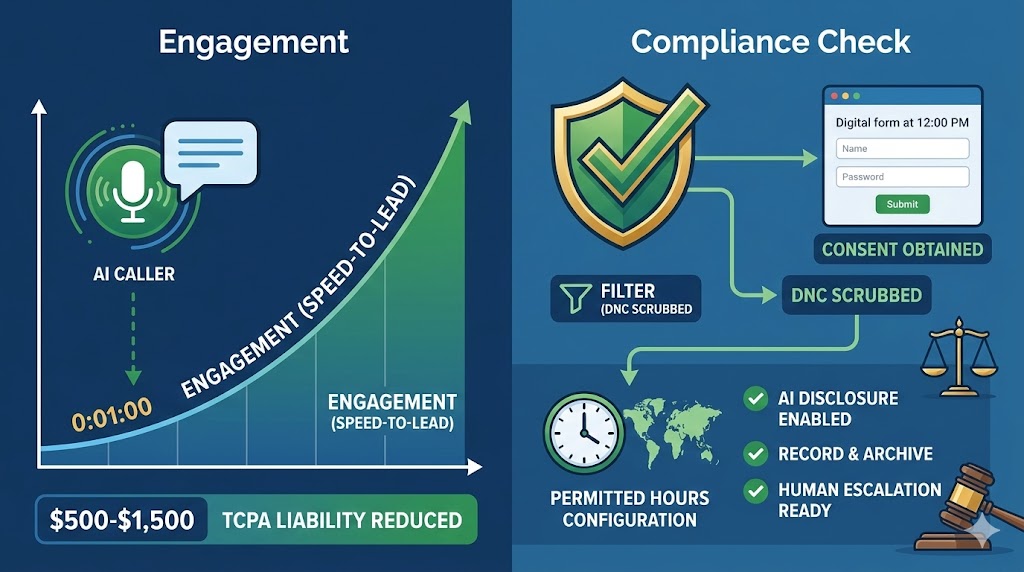
The speed-to-lead problem in insurance is well documented. When a prospect fills out a quote request, clicks on an ad, or submits a contact form, the window for effective follow-up is measured in minutes, not hours. Studies consistently show that leads contacted within five minutes of their inquiry are dramatically more likely to convert than those contacted even thirty minutes later.
Most independent agents cannot respond that fast. They are in appointments, handling claims, or managing existing clients. By the time they pick up the phone, the lead has moved on or been contacted by a competitor.
AI callers solve this timing problem. They can initiate contact within minutes of lead capture, qualify the prospect’s intent, and route qualified leads to a human agent with context. But the technology sits squarely in the crosshairs of telemarketing law. The TCPA imposes penalties of $500 to $1,500 per violation. A single improperly handled calling campaign can generate liability in the tens or hundreds of thousands of dollars.
Getting this right is not about avoiding fines alone. It is about building a lead engagement system that works reliably without exposing your license or your business to regulatory action.
What Regulators Say
FCC Declaratory Ruling on AI-Generated Voices (February 2024)
On February 8, 2024, the FCC unanimously adopted a Declaratory Ruling confirming that calls made with AI-generated voices qualify as “artificial” voices under the TCPA. This was not a new law. It was a clarification that existing TCPA protections, including consent requirements, identification disclosures, and opt-out mechanisms, apply to AI voice technologies. The ruling covers voice cloning, AI-synthesized speech, and any technology that “wholly simulates an artificial voice” or “resembles the voice of a real person taken from an audio clip.”
The practical effect: if your AI caller uses a generated or cloned voice to speak with leads, every call is subject to the same TCPA rules that govern traditional robocalls and prerecorded messages.
TCPA Consent Requirements
Under the TCPA, calls using artificial or prerecorded voices require prior express consent from the called party. For telemarketing calls (which include most insurance solicitation calls), the standard is prior express consent, which may be provided orally or in writing. The key requirement is that the consumer agreed to receive the call before it was made.
One-to-One Consent Rule: Vacated. The FCC’s proposed “one-to-one consent” rule, which would have required consumers to consent to calls from each specific seller individually, was vacated by the Eleventh Circuit Court of Appeals on January 24, 2025. Under the current standard, a single consent can cover multiple sellers if the disclosures are clear and compliant. However, best practice remains to obtain consent that is as specific as possible to your business.
Do Not Call Requirements
Insurance agents using AI callers must comply with both the National Do Not Call Registry and any company-specific DNC lists. Telemarketers are required to scrub their call lists against the National DNC Registry at least every 31 days. Exemptions exist for established business relationships (transactions within the past 18 months or inquiries within the past 3 months), but these exemptions require careful documentation.
State Telemarketing Laws
State requirements add additional layers. Some states impose calling-hour restrictions (typically no calls before 8:00 AM or after 9:00 PM local time), require state-level telemarketing registration, or impose additional consent requirements beyond the federal baseline. Florida, for example, has enacted rules requiring AI disclosure and prohibiting AI calls during restricted hours. Insurance-specific telemarketing exemptions exist in some states but vary significantly in scope.
Proposed FCC AI Disclosure Rules
The FCC has proposed, but not yet finalized, rules that would require callers using AI-generated voices to clearly disclose at the beginning of each call that the call is using AI-generated technology. While these rules are still in the comment and review phase, several states have already moved ahead. Utah (SB 149) requires disclosure of generative AI use when asked. California has proposed legislation requiring real-time disclosure. The direction of regulation is clear: AI callers will need to identify themselves as AI.
Canadian Considerations
In Canada, the Canadian Radio-television and Telecommunications Commission (CRTC) administers the National Do Not Call List (DNCL), and similar consent-based frameworks apply. Agents operating across the border should treat Canadian prospects with at least the same level of consent and disclosure rigor applied to US contacts, plus compliance with CASL (Canada’s Anti-Spam Legislation) for any text or email components of multi-channel outreach.
Common Mistakes
- Assuming “warm leads” do not require consent. A lead who fills out a form on a third-party comparison site has consented to contact from that site, not necessarily from your agency. The consent chain matters. If the lead’s consent does not clearly extend to your business, you need separate consent before an AI caller contacts them.
- Ignoring the DNC Registry for AI calls. The FCC ruling makes clear that AI-generated voice calls are subject to the same DNC requirements as traditional telemarketing. AI callers must scrub against the registry. There is no technology exemption.
- Failing to disclose AI use. Even where federal rules are not yet finalized, the regulatory trajectory is unmistakable. Agents who deploy AI callers without disclosure are building on a foundation that regulators are actively working to require. Proactive disclosure is both a compliance safeguard and a trust signal.
- Not recording consent. Oral consent is legally sufficient under the TCPA, but if you cannot prove the consent was given, it is as good as no consent at all. Record and archive the consent event, whether it is a form submission, a recorded verbal agreement, or a signed authorization.
- Calling outside permitted hours. AI callers operate around the clock, which is an advantage for responsiveness but a liability if the system is not configured to respect calling-hour restrictions. Most states prohibit telemarketing calls before 8:00 AM and after 9:00 PM in the called party’s local time zone.
- Using AI voice cloning without authorization. If your AI caller uses a cloned version of your voice or another person’s voice, you need authorization from the voice owner. The FCC ruling specifically addresses voice cloning technology, and unauthorized use of someone’s voice creates both regulatory and civil liability.
Compliant Alternatives
- Obtain documented consent at lead capture. Ensure your lead forms, landing pages, and intake processes include clear language authorizing follow-up contact by phone, including AI-assisted calls. Store the consent record with a timestamp.
- Implement real-time DNC scrubbing. Your AI calling system should check every number against the National DNC Registry and your internal DNC list before initiating a call. This should be automated and auditable.
- Disclose AI use at the start of every call. Even before it becomes a finalized federal requirement, begin disclosing. A brief, clear statement at the start of the call (“This is an AI-assisted call on behalf of [Your Agency]”) sets expectations and builds trust.
- Configure calling-hour restrictions by time zone. Your system should automatically determine the called party’s time zone and restrict outbound calls to permitted hours. This is a configuration requirement, not a best practice.
- Escalate to human agents for complex conversations. Use the AI caller for initial contact, qualification, and scheduling. When a lead is ready for a substantive insurance discussion, route them to a licensed human agent. This respects the regulatory principle that AI assists but does not replace human judgment in regulated advice contexts.
- Archive all call records. Retain recordings, transcripts, consent documentation, and call metadata for at least three years, or longer if required by your state’s insurance regulations.
AI-Specific Considerations
The intersection of AI voice technology and insurance telemarketing creates a compliance environment that is more demanding than either domain alone. Three issues deserve particular attention.
Voice Cloning and Identity
AI callers that use voice cloning to sound like a specific person raise distinct regulatory questions. The FCC’s February 2024 ruling explicitly addresses technologies that “resemble the voice of a real person taken from an audio clip.” If your AI caller is cloned from your own voice, ensure you have documented authorization in your platform’s records. If it uses a synthetic voice that does not clone a real person, the consent and disclosure rules still apply, but the voice-identity issue is less fraught.
Consent for AI-Specific Calls
The FCC has proposed adding a consent disclosure requirement specifically for AI-generated calls: consumers should be informed that their consent to receive artificial and prerecorded calls may include consent to receive AI-generated calls. While this is not yet finalized, agents who update their consent language now to include explicit reference to AI-assisted calling will be ahead of the requirement when it takes effect.
Recording and Archiving AI Calls
AI callers generate data that traditional calls do not: the AI model’s decision-making logic, the qualification criteria applied, the escalation triggers, and the full transcript. All of this is potentially discoverable in a regulatory inquiry or litigation. Agents should ensure their AI calling platform retains this data in a compliant, retrievable format. For more on archiving obligations, see the companion article on insurance marketing record retention requirements.
Roomvu Implementation Example
Roomvu’s AI Caller, Alex, is designed to operate within the compliance framework described above. Rather than being a general-purpose robocalling tool, Alex is purpose-built for regulated professional lead follow-up and operates with several structural compliance advantages.
Pre-CRM Engagement
Alex operates before the CRM. When a lead enters the system through a web form, ad click, or referral source, Alex initiates contact within the critical first-contact window. This is not unsolicited outreach. Alex engages leads who have already expressed interest, which establishes the consent foundation required under the TCPA.
The 18-Touch Framework
Alex does not make a single call and stop. The system executes an 18-touch nurturing sequence across voice calls, SMS, and email. Each touchpoint is timed and triggered based on the lead’s response behavior. This multi-channel approach means that if a lead does not answer a call, the system follows up through less intrusive channels rather than calling repeatedly.
Qualification and Human Escalation
Alex qualifies leads based on expressed intent, timeline, and engagement signals. When a lead is ready for a substantive conversation, the system escalates to the human agent with context: what was discussed, what the lead’s needs appear to be, and where they are in the decision process. The agent steps in informed. Alex does not attempt to provide insurance advice, quote policies, or make coverage recommendations. Those conversations happen with licensed professionals.
Trackable, Archivable Workflows
Every interaction Alex initiates is logged in Roomvu’s system. Call records, SMS messages, email sequences, and lead status changes are all retained and accessible. This provides the documentation trail that compliance officers and regulators expect. For agents looking at the full platform, the Roomvu pricing page outlines plan options, and the tutorials section covers setup and configuration.
Compliance Checklist for AI-Assisted Calling
- Confirm that your lead capture forms include clear consent language authorizing phone contact, including AI-assisted calls
- Store all consent records with timestamps, source URLs, and the specific consent language the lead agreed to
- Scrub all outbound call lists against the National DNC Registry (US) or DNCL (Canada) at least every 31 days
- Maintain an internal company-specific DNC list and honor opt-out requests within 10 business days (per FCC 2025 guidelines)
- Configure your AI caller to restrict outbound calls to permitted hours (no calls before 8:00 AM or after 9:00 PM in the called party’s local time zone)
- Disclose AI use at the beginning of each call, even if not yet required by finalized federal rule
- If using voice cloning, retain documented authorization from the voice owner
- Ensure your AI caller does not provide insurance advice, quote policies, or make coverage recommendations
- Escalate qualified leads to licensed human agents for substantive insurance discussions
- Archive all call recordings, transcripts, and metadata for at least three years or the longer period required by your state’s insurance regulations
- Register for state telemarketing permits where required by state law
- Review and update consent language annually to reflect evolving FCC and state requirements
- Monitor the status of proposed FCC AI disclosure rules and adjust practices when finalized
- For Canadian contacts, verify compliance with CRTC DNCL rules and CASL for any text or email follow-up
Disclaimer: This content is for educational marketing guidance only and does not constitute legal or regulatory advice. Agents should confirm requirements with their carrier, MGA, or licensing authority.
Frequently Asked Questions
Must my AI caller explicitly say “I am an AI” at the start of every call?
As of this writing, there is no finalized federal rule requiring that specific language. However, the FCC has proposed rules that would require clear disclosure of AI-generated voice technology at the beginning of each call. Several states, including Utah, already require disclosure of AI use when asked. California has proposed real-time disclosure requirements. Given the regulatory direction, disclosing AI use proactively at the start of each call is the compliance-forward approach and builds trust with prospects rather than eroding it.
Can I use my AI caller to contact leads from third-party lead vendors?
This depends entirely on the consent chain. If the lead vendor obtained consent from the consumer that clearly extends to your business or to third parties in your industry, you may have a basis for contact. However, the consent language on the vendor’s form must be specific enough to cover your outreach. Vague or buried consent language is a liability. Review the exact consent disclosures your lead vendors use, and confirm that they meet TCPA standards. The Eleventh Circuit’s vacating of the one-to-one consent rule means multi-seller consent is currently permissible, but the consent must still be clear and voluntary.
What is the penalty for making an AI call without proper consent?
Under the TCPA, the penalty for calls made without consent using artificial or prerecorded voices is $500 per violation, which can be increased to $1,500 per violation for willful or knowing violations. Each individual call constitutes a separate violation. A calling campaign to 1,000 leads without proper consent could generate $500,000 to $1,500,000 in statutory damages. Beyond TCPA penalties, state attorneys general can pursue additional enforcement actions, and insurance regulators may take separate disciplinary action against the agent’s license.
Does calling a lead who submitted a quote request count as having consent?
Generally, yes, if the quote request form includes language authorizing follow-up contact by phone. A consumer who voluntarily submits their phone number on a form requesting insurance information has typically provided prior express consent for contact related to that inquiry. However, the form language matters. If the form does not mention phone calls, or if it only authorizes email contact, the consent may not extend to voice calls. Review your forms carefully. For AI-assisted calls specifically, consider adding explicit language noting that follow-up may include AI-assisted calls. Visit the Roomvu Academy for guidance on structuring compliant lead capture workflows.