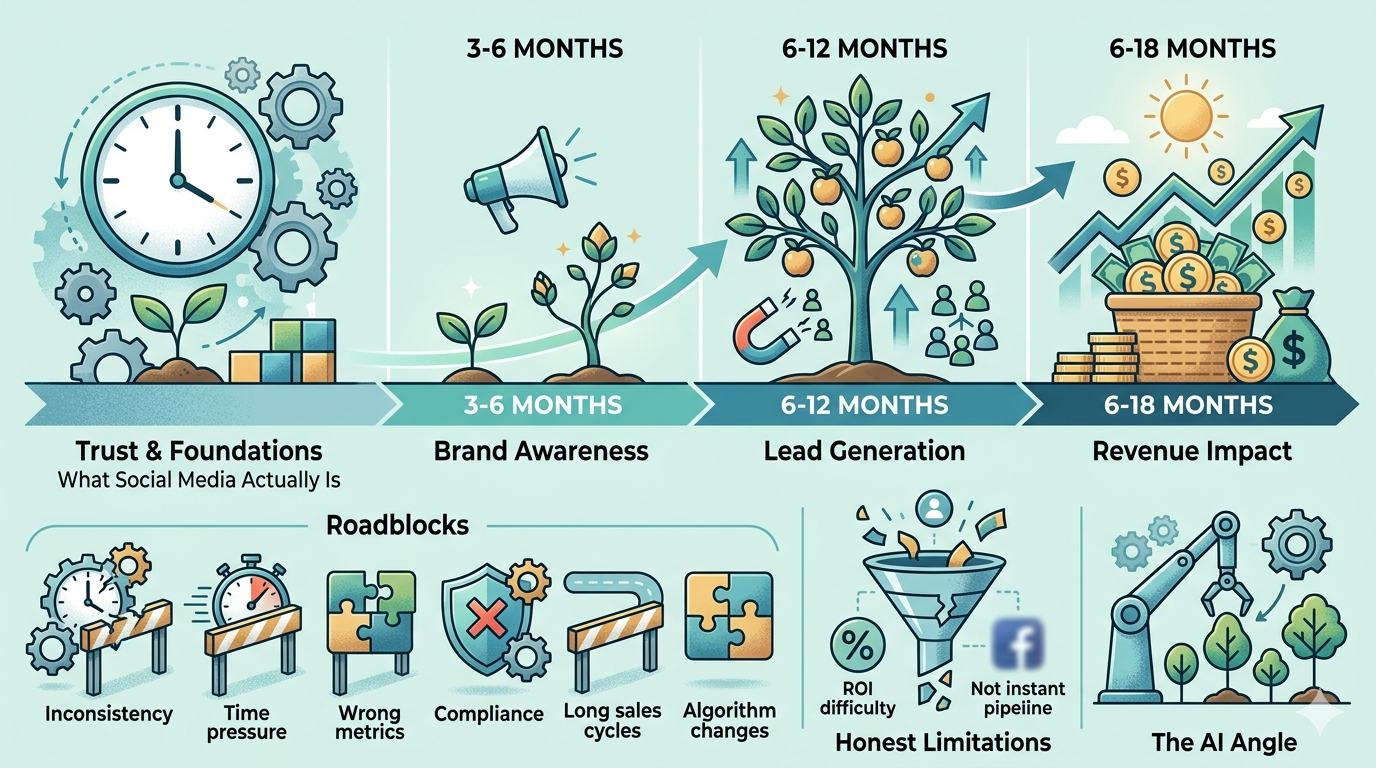
Social media is one of the most powerful marketing tools available to real estate agents, mortgage brokers, insurance agents, and financial advisors. But it is also one of the most misunderstood. Many professionals start with high expectations, post for a few weeks, see little direct lead flow, and conclude it does not work. The reality is more nuanced — and requires considerably more patience. This guide sets honest, evidence-based expectations.
The Numbers Behind the Timeline
6-9 mo
before genuine brand awareness begins to build
6-12 mo
before meaningful lead generation typically starts
44%
of marketers could measure social ROI after 2 full years
20-40%
higher lifetime value from social media customers vs other channels
What Social Media Actually Is for Your Business
For professionals in real estate, mortgages, insurance, and financial services, social media is not a lead generation machine in the traditional sense. It is a trust-building and visibility platform. Think of it less like a direct mail flyer and more like having a presence at every community event in your city, consistently, over years.
What it IS
A long-term visibility and trust-building tool. A place where potential clients discover you, follow you over months, and eventually reach out when they are ready. For high-trust service industries, the sales cycle is long by nature — social media supports that cycle.
What it is NOT
An immediate lead pipeline. Social media does not replace outbound prospecting, paid ads, or referral networks in the short term. Expecting closed deals within the first 30-60 days of posting is the most common cause of early abandonment.
What it becomes
Over 6 to 18 months of consistent posting, an owned audience that trusts your expertise. Referrals from people who have been following you. Inbound inquiries from prospects who already feel they know you before the first conversation. This is the compounding return.
The Realistic Timeline: What to Expect and When
| Phase |
Timeframe |
What typically happens |
What NOT to expect yet |
| Foundation |
0-3 months |
Profile growth, early engagement, algorithm learns your content. Brand voice takes shape. |
Leads, calls, or direct business inquiries. |
| Recognition |
3-6 months |
Followers start recognising your name. Engagement improves. First DM conversations may begin. |
Consistent lead flow or measurable revenue impact. |
| Trust Building |
6-12 months |
Warm audience builds. Referrals from followers increase. Prospects reach out having followed you silently for months. |
Overnight spikes. Growth is gradual and often invisible until it compounds. |
| ROI Phase |
12-18+ months |
Inbound leads from social become measurable. Your content library works as a 24/7 trust signal. |
This phase only arrives for those who did not quit during phases 1-3. |
Common Roadblocks and Burdens That Cause Problems
Inconsistency
The single biggest cause of failure. Posting heavily for 3 weeks then going quiet for a month trains the algorithm to deprioritise your content — and trains your audience to forget you. Consistency over a long period always outperforms short bursts of effort.
Time pressure
Real estate agents, mortgage brokers, and financial advisors are client-facing professionals with demanding schedules. Creating content while managing clients, compliance, and closings is a genuine burden. This is precisely why AI-assisted content tools have become standard practice in these industries.
Wrong metrics, too early
Checking follower count and likes after week 2 and concluding the strategy is not working. Social media ROI is a lagging indicator. Only 44% of marketers could measure it after two full years. The right early metrics are: posting consistency, engagement rate, and profile visits.
Compliance restrictions
Mortgage brokers, insurance agents, and financial advisors operate under strict regulatory frameworks that limit what they can say about products, guarantees, and performance. Content must be reviewed, approved, and compliant — adding real friction to the publishing process that most industries simply do not face.
High-trust sales cycles
Someone choosing a financial advisor or insurance agent is making a high-stakes decision. They do not buy impulsively. They research, follow, observe, and only reach out when trust is sufficiently established. This natural sales cycle makes social media timelines longer than in low-stakes categories.
Algorithm changes
Social platforms regularly shift what content they prioritise, how organic reach is distributed, and what formats perform best. Strategies that worked in 2023 may underperform in 2026. This ongoing adaptation is a real and recurring burden for solo operators.
What Social Media Cannot Do Alone
Replace a full sales process
Social media generates awareness and warm prospects. It does not replace follow-up calls, CRM systems, nurture sequences, or the human relationship that closes deals in professional services.
Deliver instant clients
A first-time homebuyer does not see one Instagram post and immediately call a mortgage broker. They follow, research, compare, and decide over weeks or months. Social media is a touchpoint in a longer journey, not the entire journey.
Work without a clear niche
Generic content about “the housing market” or “insurance tips” competes with thousands of others. Social media works best when content is specific, personal, and speaks directly to a defined audience in a defined location or specialty.
Replace client experience
The best social content cannot substitute for delivering real value to real clients. Satisfied clients who post reviews and referrals will always outperform any posting strategy.
Work without tools or budget
Organic-only social media growth in 2026 is slower than ever. Algorithms increasingly favour paid content. A modest ad budget or AI tools to maintain consistency significantly accelerates what organic effort alone cannot achieve.
What Realistic Success Looks Like
| Timeframe |
Realistic success indicator |
| Month 1-2 |
Consistent posting habit established. Profile looks professional. First 50-100 followers gained. |
| Month 3-4 |
Engagement rate improving. Profile visits increasing. Some inbound DMs or comments from potential clients. |
| Month 6 |
Recognisable presence in your local market or niche. Referrals from people who “saw you on social.” First attributable enquiry. |
| Month 9-12 |
Regular inbound interest. Warm leads that already know who you are and what you do before the first conversation. |
| Month 12-18+ |
Measurable ROI. Closed business that traces back to social media touchpoints. A content library that works passively. |
How AI Marketing Tools Change the Equation
The biggest burden for individual professionals is not strategy — it is time. AI-powered marketing platforms address this directly. When a real estate agent, mortgage broker, insurance agent, or financial advisor uses AI to maintain a consistent content schedule without writing every post from scratch, the consistency problem that kills most social strategies is solved.
Consistency without burnout
AI tools allow professionals to publish 3-5x per week without the manual effort that makes consistency unsustainable for busy client-facing roles.
Personalised content at scale
AI generates content tailored to a specific market, neighbourhood, or client type — addressing the niche specificity problem that generic content cannot solve.
Faster trust-building
More consistent, higher-quality content accelerates the trust-building timeline. AI does not eliminate the wait, but it meaningfully shortens it.
Sources: funnl.ai Social Media ROI Timeline 2026 • Social Media Examiner ROI Survey • HubSpot State of Marketing 2026 • Sprout Social 2026 Content Strategy Report • Metricool 2026 Social Media Study • SEO Design Chicago Marketing Timelines